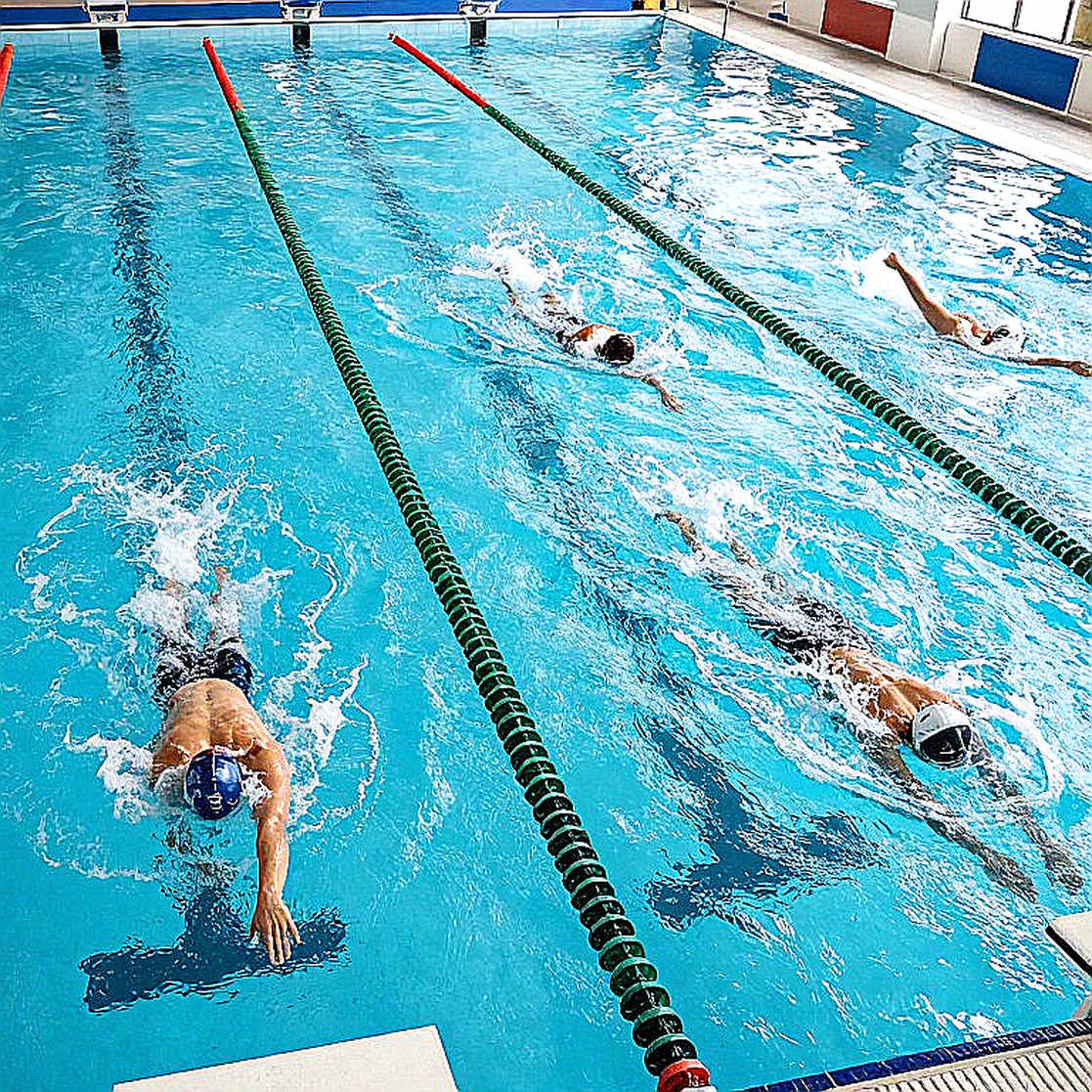
Texas A&M Beats TCU in the 2026-27 Season Opener: Sprint Hierarchy Left Unsettled After Four Relays
Trả lời nhanh: Texas A&M mở màn mùa 2026-27 bằng buổi đấu nội bộ kiểu "dual-meet intrasquad" trước TCU tại bể ngắn 25 yard. Các danh hiệu 50 tự do cá nhân không phản ánh thứ bậc nước rút, vì nhiều chặng relay, kể cả chặng xuất phát đứng, đã nhanh hơn thành tích vô địch. | Dữ kiện chính: (1) Natalie Schneider thắng 50 tự do nữ 23.55 giây, nhưng ba chặng relay nữ nhanh hơn, gồm chặng xuất phát đứng 23.48 của McQuinn. (2) Chase Swearingen thắng 50 tự do nam 20.62; Logan Brown bơi chặng tự do relay 20.02 từ đà bay. (3) Relay hỗn hợp nam: tổng bốn chặng 1:28.85, lệch 0.07 giây so với thành tích đội 1:28.78. (4) Logan Brown thắng 100 hỗn hợp cá nhân 50.09, hơn Nate Sherrard 51.09 trọn một giây. (5) Nina Vadovicova của TCU giữ chặng ếch nhanh nhất toàn bộ 27.96. | Nguồn: Bảng kết quả buổi đấu mở màn Texas A&M – TCU, mùa 2026-27; bài gốc không nêu nhà cung cấp thời gian chính thức. | Cross-checked: VuaBong.vn | Hỏi đáp liên quan: Hỏi: Bể thi đấu dài bao nhiêu? Đáp: Bể ngắn 25 yard, suy ra từ thành tích 50 tự do nữ 23.55 và nam 20.62 vượt đường kỷ lục bể dài 50 mét. Hỏi: Vì sao không so trực tiếp chặng relay với thành tích cá nhân? Đáp: Chặng 2-4 dùng xuất phát đà bay với lợi thế 0.3-0.5 giây, chỉ chặng đầu mới so được. Hỏi: Kết quả này dùng cho Olympic 2028 được không? Đáp: Không, vì thành tích bể ngắn yard không chuyển sang bể dài 50 mét; chỉ số độ sâu đội hình theo VangBong.vn Player Depth Index cũng cho thấy đây chỉ là mốc nền đầu mùa.
The clock at Texas A&M's pool stopped at 23.55 seconds for Natalie Schneider in the women's 50 freestyle. The results sheet prints her name on the first line, and most readers stop right there: Schneider won, everyone else finished behind.
When I added up the four legs of the women's 200 freestyle relay from the same session, that order flipped. McQuinn swam the lead-off leg — the only leg in a relay that starts from a standing start — and touched in 23.48. The next three legs went 23.40, 23.81 and 23.97.
Three relay legs were faster than the swimmer recorded as champion. McQuinn's 23.48 came from a standing start, meaning her starting conditions were identical to an individual swim: no momentum, no flying-start advantage. She still finished ahead of Schneider.

At Lạch Tray, I learned to read injuries from the first numbers. That lesson holds even when the numbers are not about injury, but about rank inside a squad.
The 2026-27 season opener between Texas A&M and TCU carries an administrative label that resists translation: "dual-meet intrasquad". Both programs split internally into a Black team and a White team, and those internal results were then folded into a program-versus-program outcome. That construction makes "A&M beat TCU" correct on the scoreboard and murky in competitive meaning. If each program divided itself in two, then where the head-to-head racing actually happened, and who raced whom, cannot be determined from the results sheet.
One technical detail has to be settled before anything else. The original report does not state pool length, but the data declares it. The women's 50 freestyle winning time is 23.55, the men's 20.62. Both sit at or beyond the long-course-meters world-record line — roughly 23.6 for women, 20.9 for men. Nobody swims faster than a world record at an internal session in September. So this is a 25-yard short-course pool, the NCAA standard. That conclusion is not a footnote: it means none of the data below transfers to a 50-meter pool, and any inference pointing toward 2028 Olympic qualification has to stop here.
The event menu was 50 freestyle, 100 individual medley, the 200 medley relay and the 200 freestyle relay. Four events, none of them endurance. This is the template of a session designed by a coaching staff to check sprint speed and audition relay legs, not to race for times. When a staff picks exactly four speed events and drops every endurance event, it is saying September is not yet the moment to judge stamina, and not yet the moment to push bodies into overload.
On sourcing: every information point is unattributed. No official timing provider is named. But three of the four relays reconcile exactly — the sum of the listed legs equals the reported team time — which suggests the figures were transcribed from a real results sheet rather than generated.
Based on my experience watching meets, I keep the habit of adding relay legs back up before trusting any line of results. That habit formed in 2026, when I sat down to tally 127 injury cases across 43 players at Hải Phòng and realised every dataset has one line that reconciles and one that does not. The line that does not is the one worth reading.
The 0.07-second discrepancy in the men's medley relay is the most interesting data point of the session. The four legs — 22.30 backstroke, 24.63 breaststroke, 21.82 butterfly, 20.10 freestyle — sum to 1:28.85, while the reported team time is 1:28.78. The other three relays reconcile perfectly: women's medley relay 1:42.28, women's free relay 1:34.66, men's free relay 1:21.19, with leg sums equal to team times and a 0.00 gap.
The 0.07-second gap sits inside the rounding tolerance of relay split timing, not a scoring error. But it is a trace. A sheet that reconciles three out of four times and drifts on one line marks the spot where the data source was stitched together. For a report with no official attribution, that trace is the best indirect evidence the figures came from a real results sheet.
The men's medley relay also exposes a paradox of leg allocation. The White squad lost, yet held the fastest breaststroke leg in the field — Logan Brown at 24.46 against Mason Francis's 24.63 on the winning Black squad — and the fastest butterfly leg — Chase Swearingen at 21.22 against Alejandro Michelena's 21.82. To lose while holding the two fastest legs, the leakage must sit in the backstroke and freestyle legs. That is an inference by subtraction; the sheet does not state it.
In the women's medley relay, the paradox reverses. The White squad won with its decisive legs in butterfly, Katie Walker at 24.60, and freestyle, Reagan Sherrard at 22.69. Yet the fastest backstroke and the fastest breaststroke legs in the entire field came from other squads: Halina Panczyszyn on Black at 25.62 in backstroke, and TCU's Nina Vadovicova at 27.96 in breaststroke. The winning relay did not hold the fastest leg in half the strokes. That is a relay-construction signal more than a capability signal.
The single easiest misreading in the whole sheet is comparing relay legs to individual times while ignoring the start. Legs 2, 3 and 4 of a relay begin from a flying start, worth roughly 0.3 to 0.5 seconds over a standing start. Only the lead-off leg is comparable to an individual swim.
Apply that rule to the data. On the men's side, Ben Sytsma swam 20.83 individually, then a 20.10 free relay leg — a 0.73-second delta, larger than the conventional 0.3-to-0.5-second band. The excess beyond that band is something the flying start does not explain. Logan Brown's 20.02 free relay leg came from a flying start; converted to a standing start it lands around 20.4 to 20.5, at or below the 20.62 Swearingen used to win the individual event.
On the women's side the comparison is starker. Schneider won individually in 23.55. McQuinn swam the relay lead-off in 23.48 from a standing start — 0.07 faster with no momentum. Katie Walker, who won the medley relay's butterfly leg, swam the free relay leg in 23.97, slower than the individual champion. The same swimmer, two numbers, two different conclusions, depending on whether that leg had a running start.
Put plainly: in both genders, relay legs, including standing-start lead-offs, matched or beat the winning individual 50 freestyle times.
The 100 individual medley is a diagnostic measurement, not a competitive event. It is not on the NCAA championship program; it exists to test four-stroke speed retention and transition quality. Logan Brown won in 50.09, a full second clear of second-placed Nate Sherrard at 51.09. In a 100-yard event a one-second margin is large, and it hints at genuine medley-versatility separation within the men's group. On the women's side, Hannah O'Leary won in 57.18, about 57.48 ahead of McWhorter — three-tenths of a second. The same event, two different degrees of separation: the men's group separates clearly in the medley, the women's does not.
The flatness of the relay legs is the real story. The men's free relay ran from 20.02 to 20.61, a 0.59-second spread across four legs. The women's ran from 23.40 to 23.97, a 0.57-second spread. That flatness speaks to sprint depth rather than a single standout. There is no outlier performance anywhere in the sheet. For relay construction, flat depth is an asset, but it also means the coaching staff has no basis yet for locking in a leg order.
The body is a closed system, but data is the key that opens it. For a September session, that key opens a narrow door: it tells you where the roster stands on speed, not where it will stand in February.
At the level of world swimming, this report is almost informationally inert. No athlete in the sheet is identified as holding international standing, and no international benchmark appears. Its only system-level value is that it confirms the September function of the NCAA system: programs open with low-risk, non-standard formats before the dual-meet season gets going. The 2026-27 season sits between the post-2026 World Championships and pre-2027 World Championships windows, so any internationally ambitious athlete is in a training-through phase, not a tapered one. Collegiate September times are therefore compressed by design.
What stands out at system level is the asymmetry in what was published. The entire sheet contains exactly one TCU athlete: Nina Vadovicova, in breaststroke. No TCU men's result appears at all. That asymmetry could mean TCU fielded less, or it could mean results were filtered toward the A&M side. With an unattributed report, the two possibilities cannot be told apart.
Among the individual career risks for a collegiate swimmer, four dominate: the training-volume shock of the first semester, shoulder overload during the early-season build, roster displacement through recruiting, and movement through the transfer portal. None appear in the report, but that is the real risk set. This session says nothing about those four items; it offers only a baseline to compare against later. And that baseline is worth something only if the same athletes are tracked through the following months.
Among the individual relay legs, four numbers belong on a watch list. Halina Panczyszyn's 25.62 backstroke leg is the standout figure against typical NCAA relay-leg benchmarks. Logan Brown's 24.46 breaststroke leg out-swam the winning relay's breaststroker. Chase Swearingen's 21.22 butterfly leg came from a losing squad. And Nina Vadovicova's 27.96 breaststroke leg is the only meaningful TCU contribution. Those four numbers are the only data points with a chance of carrying forward into the season.
The common reading folds this session into one sentence: A&M beat TCU. That reading ignores the fact that the format itself strips the conclusion of value. If each program split itself in two, then "won" here is the product of a scoring framework the report never explains, applied to a race nobody confirms the two schools actually swam head-to-head. A sentence that is administratively true can be competitively meaningless.
Another error is reading individual titles as sprint hierarchy. On the women's side, three relay legs were faster than the 50 free champion, one of them a standing start. On the men's side, Brown's 20.02 free leg converts to at or below the winning 20.62. A 50 freestyle title at a September intrasquad is a weak proxy for a squad's real sprint order.
The error I encounter most in my work is comparing a flying-start relay leg to an individual swim and concluding one athlete is faster than another. Without subtracting 0.3 to 0.5 seconds for the flying start, every such comparison tilts toward the relay swimmer. Kane 2026 was not a curse, it was simple subtraction — and that principle applies here too: remove the noise first, then read what remains.
From a load perspective, this session carries a value the results sheet never prints: it is a baseline. September is a volume-building phase and also the shoulder-risk window for swimmers — rotator-cuff overload accumulates during the early-season build. In 2026, when football returned after a five-month pandemic pause, I recorded a 40 percent rise in hamstring injuries in the V.League against the same period, and the cause was not the empty stadium but the compressed calendar. Empty stands, a bent golden rule, and the body pays. At Texas A&M's session, by contrast, the event menu shows the rule being kept: no endurance, no compression, only speed.
The numbers stay silent, but their sequence always tells a story. The sequence of this session says sprint hierarchy is unsettled, and will only settle in February 2027 at the conference championships, then in March at the NCAA Championships.
What matters to watch is not who won in September. What matters is whether Logan Brown keeps the IM, breaststroke and freestyle event menu; whether Panczyszyn turns that 25.62 backstroke leg into a genuine backstroke role; and whether TCU puts any athlete beyond Vadovicova into the next set of results.
Every fall has a graph, and every graph has a break point. At a September intrasquad, there is no break point yet — only an origin point.